Pears, Honey
by Susan Rose April
“The house is a two hour drive,” Jim Kawecki tells me, “Hope it’s not too far for you.” I say, “Nah, fine,” and he hands me the radon test kit. He instructs: “Goes in the center of the lowest spot—basement, if there is one. Just peel off the top and place it, arrow side up on the floor.” He demonstrates. I nod and don’t ask too many questions. I’m happy to drive north in cool October, out of Washington DC and up to Amish country. He talks further, but I’m busy gathering my things. A day out of the office? This is great. I hear: York. First exit. New Freedom. Gravel drive. Vacant. “Gotcha,” I say and I’m off.
You with me?
Because this happened thirty-five years ago and my memory’s spotty. Closing my eyes, I see windy back roads (chose not to take I-83), a water-powered mill with an Antiques sign (mental note: hit that on the way back), crossroads called Glen Rock (if you blink, you miss it), then brute chunks of bulldozed land (the new Interstate exit Jim talked about when I wasn’t listening) and a road sign: “Entering New Freedom,” which I nearly missed. More twists and turns. Me getting lost. Me digging out the map (pre-GPS). Me backtracking to a more-dirt-than-gravel gravel drive hidden by willows, a mailbox smashed with a baseball bat it seems to me, and a hex sign floating face-up in a scummy green pond.
This is. This was. The place.
The house was made of fieldstone. The house had two doors side-by-side. The house looked haunted, but I was not afraid. There was a clothesline. I walked in.
If a woman lived there, her name would be Artheda. She would have been married to Millard E. Wolfe and they would have farmed the 180 acres from 1942 to 1978. Everything is as it was, circa 1978. I see the parlor’s chunky wooden couch with tweed plaid cushions—exact duplicate of my mother’s old Sears sofa set—but worn and mouse-nibbled. A few TV trays, still set for eating. No TV. Nothing electric.
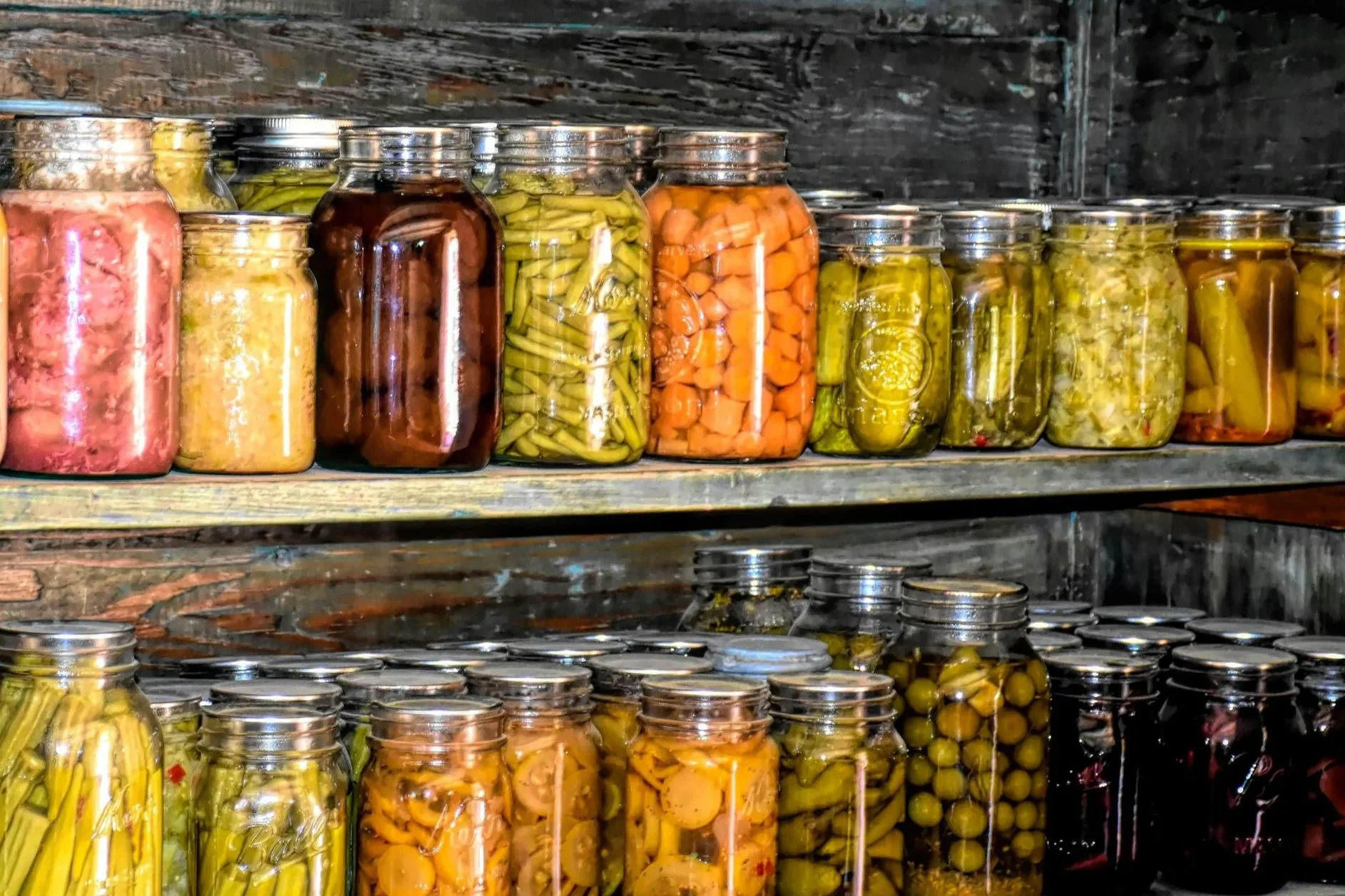
In the kitchen—sorry, but I can’t see the kitchen, because when I turn left out of the parlor, I’m stopped, floored really, by a long hallway, lined floor-to-ceiling with cans and I don’t mean Green Giant niblets. It’s a gallery: beautiful shelf-upon-shelf of home-canned fruits, jellies, preserves, piccalilli (still don’t know what that is). I struggled—still struggle—to comprehend why all of this bounty, so well preserved, so clearly once loved, remained. Unloved. Abandoned. Why?
Artheda wrote every label in black ink, clean print, very descriptive:
Homemade Hard Candy: Butter-Nut
Raspberry Jam: Wurzbacher Bushes
Yellow Mustard Eggs: Grandma Orwig’s
Pears, Honey: Mine
She used Ball jars, for the most part, and topped them with calico fabric, eyelet lace, zig-zag bric-a-brac. It was a showplace. Oh, Artheda. What happened?
*
Nobody canned fruits or vegetables in our home, growing up. Certainly not my mother. We did have two very tall pear trees. I don’t know where they came from. This was a city street; our home, an old Victorian on a quarter acre lot. Not only those glorious pear trees, but a rhubarb patch growing wild along the fence-line, and three plum trees behind the dirt floor garage— originally, an old stable from horse-and-buggy days. I imagine the Victorian-era family that built the house and stable also put in the fruit trees, but I’m not sure. Still, I was grateful. Those pears saved my life.
Not to delve into family dysfunction, but our mother locked us out of the house most afternoons. “Go play,” she’d say. Snap. Click. Then she’d go for a nap. The time of locking out might vary. She’d forget to consider lunch. Our property was rimmed by a chain link fence, also locked. Of course, we could climb over and escape. We wouldn’t though—because, well, hair brushes, belts, stuff like that. My brothers played at earthmoving with toy bulldozers in the sandbox. I inspected the fruit trees and rhubarb patch.
If I was hungry—and I was always hungry—I’d gather unripe pears which were as hard as rocks and eat them as best I could. I’d mash the pulp around in my mouth, extracting some hunger-staving-off juice. And I was happy. When the pears were over-ripe and fallen in piles on the ground, attracting hornets, I’d squeeze up a concoction, a kind of pear soup, in an empty Maxwell House coffee tin. I’d drink it. And I was happy. The soup was not sweet. I hadn’t the forethought to pocket some sugar from the house supplies before lock out. We had maple syrup, but no honey. We had never even heard of honey.
If breakfast was a bust (because my brothers would make a fort out of the cereal boxes and guard it with their lives), if lunch was not forthcoming (not even a flicker of parental concern in mother’s self-therapy nap), I’d always have my pears. Mine.
*
Radon is a cancer-causing radioactive gas: colorless, odorless, chemically inert. Radon is caused by the decay of naturally-occurring uranium in solid rock. The house in New Freedom, Pennsylvania, was built of rock, and located in an area of relatively high radon occurrence.
Radon is measured in units of pico-curies per liter (pCi/L).
I emplaced a Long Term Alpha Track Radon Detector in the fieldstone with dirt floor cellar of Millard and Artheda’s abandoned farmhouse not because Jim Kawecki and Associates (Why plural? It was me, just me) had concern that cancer-causing radon would harm anyone trespassing into the home, but because this was a bulldoze job for the upcoming Stonebridge Business Park and Cracker Barrel franchise slated for that 180 acres.
Due diligence. Common practice. Bringing jobs, pancakes, and such.
I looked for the cellar door. Found it off its hinges. Looked for the hinges. Found an opening. Saw darkness. Looked for a flashlight. Found boxes of empty canning jars and lids. Found a candle. Searched for matches. Returned to my car for a small book of wooden matches in the glove compartment. Also found a penlight, but the battery was dead.
Returned to cellar opening, lit candle, stepped down something more ladder than stair, determined center-of-floor via best-guesswork triangulation. Peeled back top of the device. Looked for red arrow. Dripped wax onto my shoe tops as I lowered the radon detector. Returned up the “stairs.” Walked past Artheda’s preserves gallery. Grabbed a jar. Blew out the candle. Got into my car and drove home.
*
I don’t live in my hometown. Sometimes, for funerals or high school reunions, I visit and drive past the old Victorian. Last time, I saw the pear trees had been cut down and the entire—the entire—yard paved over. Where I made my pear juice concoction was now a concrete swimming pool. The dirt floor stable was now a gazebo-pergola-outdoor kitchen kind of place, as best I could determine, without trespassing.
I don’t drive anywhere near New Freedom, at least not on purpose. But Google Maps shows the following buildout of the old 180 acre farm: Cracker Barrel, Hampton Inn, Home Depot, Chick-Fil-A, Papa John’s, Gold’s Gym, Well Span Health, Johnson Controls.
And under it all: broken glass, paper labels, lost writings, summers in a jar and decaying uranium like you wouldn’t believe.
January 28, 2026
Susan Rose April is a Maryland-based writer of creative non-fiction. She has an MFA from Vermont College. After a successful career as an environmental scientist, she now works as a creative, crafting collage art and visual poems. Latest writings have appeared in Artemus Journal 2025: Homeward Bound; SubTerrain Magazine, Issue #100, 2025; and The Forge Literary Magazine, July 2025. Find her at susanroseapril.com.